Showing posts with label Africa. Show all posts

Monday, December 17, 2012

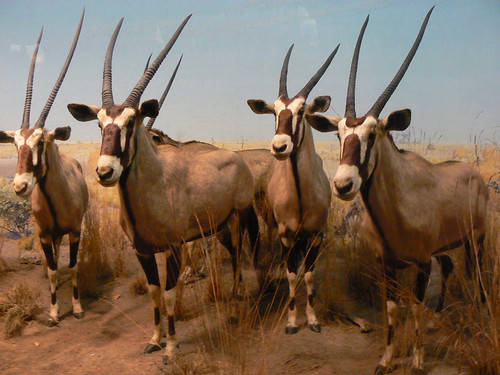
Diorama


P1030114

We've been watching Museum Secrets on the Smithsonion Channel this evening. They have been showing the American History Museum in New York. Many of the displays with the stuffed animals were pioneering efforts in the 1920's to show the animals in more lifelike poses than they had before. They even had much better taxidermy methods, which had been developed by Carl Akeley, who started his career working on the preservation of Jumbo the elephant. Unfortunately, Akeley never saw the opening of his exhibits. He died in Africa before they could open.

And here are my pictures I took while visiting the museum in 2008.


Wednesday, June 15, 2011

Senegal tour highlights soil conservation and reforestation problems.

SudOnLine - Le Portail de Sud Quotidien SENEGAL | La problématique de l'eau et du reboisement au cœur du Débat

This article describes a tour of international experts around the Thies and Kaolack regions of Senegal to talk with local farmers about soil conservation and reforestation. Led by the Senegal Eaux et Forets, there were forestry experts from Burkina Faso, Cameroun, Tunisia, and the USA. Curiously, the article didn't give any names.

I have been on and even led many such tours during my time in Africa, including this area. I wonder where they went to eat afterward?

It seems that not much as changed in the nearly 25 years since I worked there. They were talking about spreading peanut shells over soils degraded by salt encroachment. But the village had treated only 290 of 1850 hectares affected. I wonder how much time it took to do this?

At least it was encouraging that people seemed to know what the problem was and how to go about fixing it.

Monday, April 25, 2011

Chernobyl

I have been hearing on the news that this is the 25th anniversary of the infamous Chernobyl disaster. At the time we were living in Senegal and heard all the news through the BBC World Service. It was all on the radio. Our only pictures of the disaster came from news magazines, no TV.
A few months after the accident we started to notice frozen turkey wings going on sale in the market and grocery stores all over Dakar. They were also available in Dakar. When I saw some of the boxes I noticed that they were from North Carolina. They were certainly a good deal. An American turkey wing could be as big as a normal African chicken's whole leg.  I remembered buying them quite often.
I didn't realize, thought, that the Senegalese were mystified by this item for sale. In Africa, pretty much all poultry is bought live and whole. Even the well off people buy whole birds, even the already slaughtered ones, in the grocery stores. Selling parts, like we do in the USA, is almost unheard of. 
At one point, a friend I worked with, asked me if there was anything wrong  with the turkey wings. He said that there was a rumor going around that they came from Chernobyl! Maybe people thought they were all that was left. It took me a while to explain that in America, agriculture was industrialized and that it was very common to buy poultry parts. He understood, although I got the idea that he still thought we were crazy in America. You can never underestimate the power of cultural differences!

Sunday, March 07, 2010

Festival International des Masques et des Arts de Dédougou


Years ago, when I was a Peace Corps volunteer in Burkina Faso I came on a village where the people were celebrating this festival (1981). I took a number of pictures that I have been using in presentations over the years. I will have to get them scanned and pointed at some point. I am glad to see that there is a festival there now. for those of you who read French, here is an article in the local newspaper, le faso. Enjoy the video!

Sunday, December 06, 2009

Wildlife Encounters


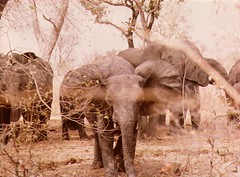
AngryElephant
Originally uploaded by P_Linehan.

While living in Burkina Faso and later Senegal Sheri and I really didn't come across much wildlife. Afer all, cattle and goats were too valuable to permit lions to roam around free. There were too many farms, too.

While visiting the National park of Po in Burkina Faso, on the Ghana, border with the forestry students, we came across this herd of elephants by the side of the road. Another instructor, Ben Bastyr, and I approached the herd with our cameras. We crouched low and took pictures. The mothers in the herd became restless as they had baby elephants with them. When we only had a few shots left we both stood up to get a final picture. As I clicked this female came after us trumpeting and flapping her ears. I have never run so fast in my life to get back to the side of the road. The students said that was the fastest they had ever seen a toubab run, too.

Fortunately, we later learned that the ditch between us and the herd saved us from attack. Also, if this were more than a warning she would never have trumpeted, just attacked. (1982 or 1983)

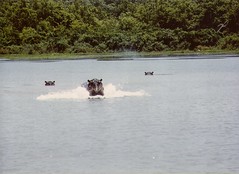
Hopping Hippo
Later, when Blaine was just an infant, Sheri and I drove up to a wetland area, La Ganguette, that was about a half hour north of Bobo Dioulasso. There was an old aluminum life boat that you could rent to go out to see the hippos. The guide rowed us out. It was about mid-day. Blaine got bitten by a fly or mosquitoes and stated wailing, as babies will do. This seemed to really upset the hippos. They started growling. Finally this one jumped up out of the water! At that point we decided to cut our trip short and go back to shore as quickly as possible. That was enough wildlife viewing for one day. (1983)
Sunday, December 07, 2008

Tabaski


I heard a story on NPR today about the Muslim festival of Eid al-Adha or Festival of Sacrifice. It commemorates the story of Abraham who was commanded by God to sacrifice his son Isaac to show his faith. At the last minute an angel appears to stop Abraham just as he is about to plunge the knife and commend him for his faith. Instead a ram appears.

In the NPR story the Kabul, Afghanistan bureau chief, Soraya Sarhaddi Nelson,
was at the cattle market to buy a calf for her staff. She was discussing how the high price of cattle caused by the war and recent drought has reduced the number of buyers. Most of the cattle sellers will lose their investment on their animals imported from Pakistan.

In West Africa the festival is called Tabaski. It was always a big deal when we lived in Burkina Faso and Senegal. Even the Christians got involved, because in Africa one person's holiday is a good reason to celebrate. I especially remember how an entire family would get new clothes to go to prayers. In many families the mother would be several pagnes (1 meter of cloth) of the same material, so all the children would be dressed the same.

This picture comes from the livestock market in Thies, Senegal. Most of these animals were imported from Mali. Often they would cost as much as a month's salary! Many people joined savings clubs, a lot like the Christmas savings clubs that banks used to offer.

Tabaski is celebrated with the same festive spirit as Christmas. And mouton stuffed with couscous can't be beat.


Friday, July 20, 2007

Come study at the Conakry Airport

This Washington Post article describes hundreds of students of all ages flocking to the Conakry Airport in Guinea to study under its fluorescent lamps. Guinea follows a French-style education system, based on high stakes exams. So, students really have to succeed to advance. Also, with the lack of textbooks and other educational resources, students become really good note takers. They also have to learn how to memorize well, skills we are losing in the United States.

When I visited Guinea last December, the airport is one of the most striking features. It is hot, dusty, and noisy. Conakry is located on a long peninsula. The airport is at the base of the peninsula. The city has grown right up to the edge of the airport. There is a blackened mosque right outside the airport terminal. I thought, at first, that it had been destroyed or burned. But I learned later that it had never been completed.

Ironically, Guinea should have more than enough electricity for everyone. the Fouta Djalon highlands have a lot of water and good locations for hydroelectric dams. The mineral wealth in Guinea, if used properly, would buy enough electric power. I worked at the C.E.E.D. (Center for Environmental Education and Development) in Kinkan, right next door to a working dam. One of the advantages to using this school for workshops is that it always has electricity. My overwhelming impression of Guineans, of all ages, is that with just a few more resources and opportunities, they can compete with and excel anywhere in the world.

Friday, January 26, 2007

Guinea Demonstrations


The community of Guineans in the USA demonstrated in Washington yesterday in support of the general strike back in Guinea. Above is a link to Aminata.com, a site which has so far had the most up to date information. I copied this picture from the ones posted.


The news of the strike and the police retaliations has started to permeate the western, english- language press. It seems that with the war in Iraq still raging only many deaths will penetrate the news organizations. I hope it doesn't came to that!
Here is a link to a Washington Post article yesterday: http://www.washingtonpost.com/wp-dyn/content/article/2007/01/25/AR2007012500730.html?referrer=delicious
Maybe as the price of aluminum goes up, the world will take notice.

Saturday, January 20, 2007

Four more killed in Guinea as crisis talks under way


AFP.com | Agence France-Presse, a global news agency

This article summarizes the situation in Guinea eleven days into the strike. It also has pictures of the burned out cars in Conakry and people lining up for gas.

I left Guinea almost two weeks ago, just as the strike was starting. There was no doubt that the people were fed up with the corruption and impoverishment of their country, especially since Guinea is such a potentially rich country. I hope the strike ends soon, peacefully and with the kind of government that Guinea deserves at last.